selfware: the newest most fun tech thing
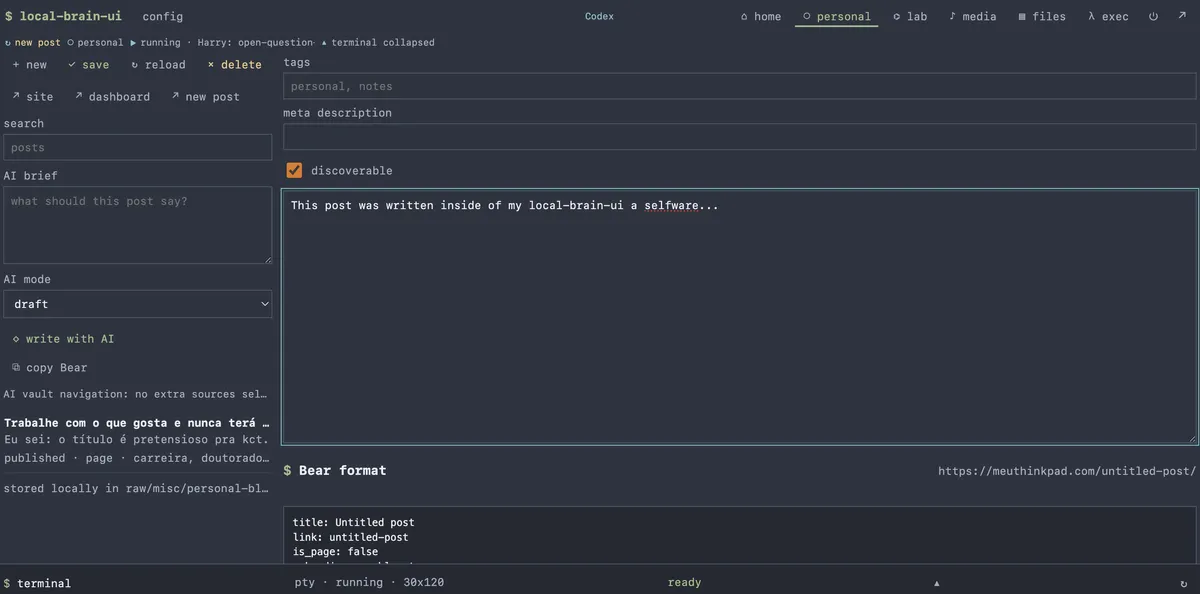
I’m writing this post from my local-brain-ui: a piece of selfware — or, if you prefer, vibe-coded personal software — inspired by ideas like LLM wikis and second brains.
The core idea is simple: a second brain doesn’t have to be just a pile of notes sitting in folders. It can become something more active — almost like an operating system connected to the way your own mind works.
In my setup, the system follows a small internal contract. The raw/ folder holds source material, captures, and private operational inputs. brain/ stores processed knowledge in Markdown. synthetics/ is where automation, generated artifacts, and AI-assisted workflows live. That structure is documented in the README.md, but honestly, the folder names are the least important part. What matters is the direction: knowledge isn’t just stored. It becomes something you can actually use.
The interface is part of that philosophy. My Brain Input UI works through the browser and acts as an entry point for raw inputs and vault operations. From there I can write diary entries, log habits, read files from the vault, trigger brain skills from a controlled whitelist, edit local text files, upload material, and connect to other tools like writing surfaces, media views, or local model routes.
In other words, it’s not another notes app. It’s a personal workspace designed around how I actually think and work.
That’s what I mean by selfware.
Selfware is software shaped around a real person. Not in the superficial sense of changing a theme color or putting your name in the header, but in a deeper sense: software that respects your actual loops. How you write. How you remember. How you revisit unfinished ideas. How you get distracted, and how you find your way back. How a diary entry connects to a project, or a book, or a video, or a half-written draft.
Most second-brain systems promise memory. But memory by itself is passive.
What I’m after is closer to an operating system for thought — a place where notes, journals, media, writing tools, research, and LLM assistance aren’t isolated islands. They can interact through local files, explicit rules, and workflows that I can inspect and control.
One example: imagine building your own version of Netflix, but with your own rules.
Not a recommendation engine designed to maximize watch time, but a personal media layer built around your reviews, your reading notes, your diary, your projects, or the books you were studying last week.
The goal isn’t just “recommend me something.”
The goal is: recommend something based on my real context, my past attention, and the direction I’m actually moving toward.
The same logic applies to writing.
A blog post doesn’t need to begin from a blank page — or from a model pretending to know who you are. It can begin from a local, controlled context: previous notes, project pages, relevant journal fragments, and the exact environment where the writing is happening.
In that model, AI doesn’t replace the writer. It helps the writing environment become aware of the system around it.
That changes the experience of using AI.
Instead of opening a chatbot and explaining your life from scratch every time, your local system already knows where to look — within boundaries you defined. It can search your vault, read your files, cite source paths, and stay local-first. It doesn’t need to pretend every answer came from nowhere.
There’s also a practical reason for building this way.
Personal knowledge systems become fragile when everything depends on memory, discipline, or a single cloud platform. Local files are boring. Markdown is boring. Folders are boring.
But boring foundations make it possible to build strange, deeply personal systems on top of them.
So local-brain-ui isn’t just an app.
It’s an experiment in making a second brain operational.
Diaries, videos, writing, raw notes, processed knowledge, automation, and LLMs all become parts of the same personal machine.
The possibilities are large — but that’s not the goal.
The goal is simpler:
To make the computer feel a little closer to how the mind already works.